Category:

From Our Blog —
From Our Blog —
From Our Blog —
From Our Blog —
From Our Blog —
From Our Blog —
May the Edits Be Ever in Your Favor
When “The Hunger Games: Sunrise on the Reaping” opens in theaters today, most audiences will be watching Haymitch. Emma Scharre will be watching the edits.
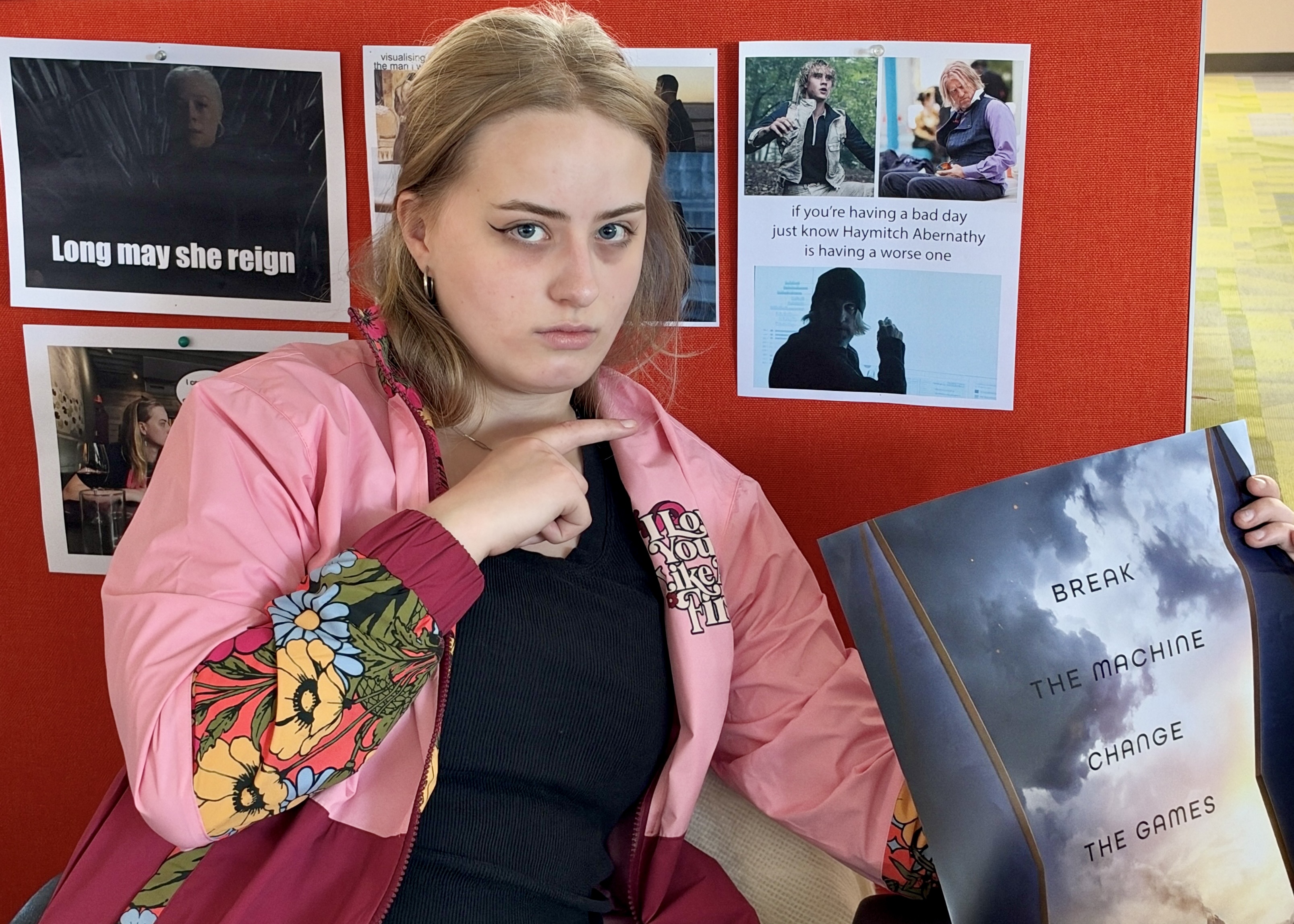
Emma is a Junior Video Editor at CVR. She’s also a book-first, cry-at-every-movie Hunger Games fan, and she’ll tell you both without hesitation. “I literally cry at every moment in the movies because it’s such a good retelling,” she said. She has her ticket for next Tuesday.
We sat down with her to talk about what gets tossed, and what survives, when a book becomes a movie. Turns out it has a lot in common with what she does here.
From fan edits to full time
Emma studied Media Production at Ball State University. She loved technical theater but not the live part of it, so she went looking for something in entertainment that didn’t happen in real time. Movies fit.
The editing instinct came earlier. Like a lot of Gen Z, she ran a fan page growing up and made edits for it. “I say this with my full chest, I am not embarrassed about it,” she said. College gave her the hard skills to go with it.
When a Ball State internship coordinator let her know about an Indianapolis agency needing a summer intern, Emma applied with a portfolio of every video she was proud of and exactly what she did on each one. About a week before graduation, she found out she’d be CVR’s Video Apprentice.
Today she’s a full-time video editor, supporting client work and pretty much all CVR social media videos. She’s quick to credit the camera and cinematography skills on our video team and loves working among so many people with different ideas.
“Editing at CVR is a lot different than narrative editing,”she said. “You get a whole team to help with creative decisions and new, fresh perspectives. Having that backup is really helpful, especially for me, who isstill brand new to the space.”
Why the book wins
Emma reads first, every time. Her argument is that a movie gives you one lens, the director’s, while a book lets you live inside a character’s head. She said “The Ballad of Songbirds & Snakes” is a strong retelling that still couldn’t give you the pages of Snow’s inner thoughts that make you “grow to hate him, even if you didn’t already.”
Film has to work around that with a legendary rule: show, don’t tell. “Instead of saying what time it is, you show the clock,” she said.
Emma also learned in film school that screenwriters generally leave camera directions out of a script, because those choices belong to the director. “When a director likes two takes equally, who decides which to use? The editor.” That’s why she calls Jennifer Lame, Christopher Nolan’s editor, underrated.
To Emma, that makes the editor the one who really shapes a film. “In the long term, it is the editor who wears the creative hat on what take gets chosen, how time flows, and more,” she said.
The stuff you feel before you notice
Ask Emma about a favorite adaptation and she’ll mention “Catching Fire,” partly for a detail most people never clock. In IMAX, the film shifts to a taller, full-screen aspect ratio once Katniss rises into the arena, and it stays there. You don’t feel fully pulled into the movie until that moment, which is the point.
Once you know what to look for, editing choices are everywhere. A Dutch angle throws a scene off balance. The color tint in “The Matrix” tells you which world you’re in. And in “Little Women,” the mix of lavalier and boom mics decides which sister’s voice cuts through during overlapping dialogue.
The importance of being intentional
So, how do you fit a 400-page book into a two-hour movie? Emma says the answer is intention. If a scene doesn’t move the story, it goes.If a character carries the story, even quietly, it stays. She points to Katniss’ Capitol prep team in “The Hunger Games,” who barely get screen time but quietly show how much image and presentation shape her world.
What bugs her most is a movie that doesn’t trust its audience. “A lot of movies spell out a message the whole film had already made.They basically tell you everything three times as if they assume you’re on your phone not paying attention.”
What she’s watching for in “Sunrise on the Reaping”
Spoiler alert!
Emma expects this to be the campiest, most colorful Hunger Games film yet. “The Capitol in this era is living in its own bubble of comfort and propaganda and think life is magical.” The louder the Capitol looks, the more it shows how far removed it is from the districts paying for it, a contrast Emma compares to celebrities arriving at the Met Gala while some people right outside the museum may be struggling or even homeless.
She’s also curious how the film handles the book’s toughest moments under a PG-13 rating. How will they carry out one of the most brutal deaths when a chariot crash turns into one of the story’s key turning points and sends Haymitch straight to Snow? Emma’s guess for how an editor might handle it: suggest, don’t show.
Small enough to fit, big enough to matter
Cutting a book into a movie isn’t so different from cutting a client’s story into a 30-second video ad. Both start with a lot of material and a search for the moments that matter most. For Emma, those are the lines that give you goosebumps in the room. “You’re like, ‘Ooh, that felt really good,’” she said. “It’s small enough to put in, but it’s also something big that helps tell the story.”
She’s learned to fight for those special moments as an editor when they’re on the chopping block. “You have to know how to defend your creative decisions,” she said. It’s the kind of judgement she doesn’t think AI can copy. “You can’t replicate that.”
Her pitch to Hollywood
If Emma could green-light one adaptation it would be “Blood Over Bright Haven” by M.L. Wang. It’s a fantasy novel, but what stuck with her is how real it feels. “We know there are problems happening, but we sometimes choose not to see them,” she said. Her pick to direct is Greta Gerwig, or maybe Guillermo del Toro. Editing would go to Evan Schiff, who recently worked onToro’s “Frankenstein.” And one day, she’d love to work on a Hunger Games movie herself. We’re not betting against her.
So if you’re catching “Sunrise on the Reaping” this weekend, try watching it the way Emma would. Notice when the colors shift, when a scene ends sooner than you expect, when the camera tilts. Somebody decided that.